
Case Study on Operations Improvement
Same Revenue, More Profit: A Cost Review for a Printing & Packaging Unit
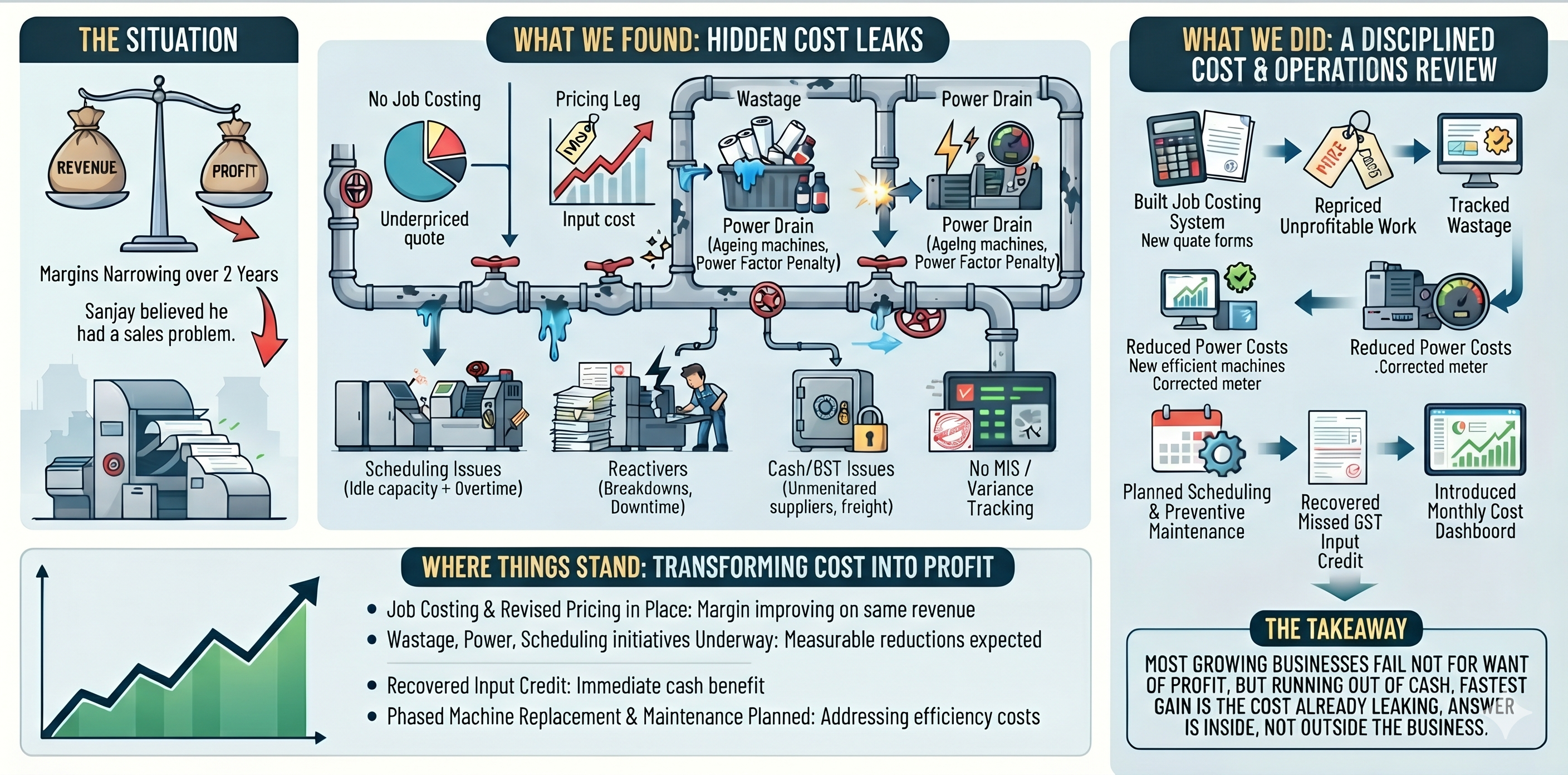
The Situation
Sanjay’s printing and packaging unit had stable revenue but margins that had narrowed over two years. Paper and ink cost more, he had already raised prices as far as customers would accept, and he had concluded that the only remedy was to win more orders. He came to us believing he had a sales problem. The early numbers suggested otherwise — the issue was less the revenue coming in than the cost leaking out.
What we found
What we did
The Result
The Takeaway
When margins narrow, the instinct is to chase more sales. Frequently the faster and more certain gain is the cost already leaking from the business. A disciplined cost and operations review tends to recover margin that was there all along — without compromising quality or pressing customers harder on price.
If revenue is holding but profit keeps slipping, the answer is usually inside the business rather than outside it.
Some names and identifying details in this case study have been changed to protect client confidentiality.
How can we support in Operations?
Comprehensive Operations solutions handled by experienced Chartered Accountants.
CA-Led Compliance
Entire registration process is prepared and reviewed by qualified Chartered Accountants, ensuring professional-grade accuracy.
Accuracy Guarantee
Our multi-level verification process ensures error-free registration, protecting you from notices and penalties.
Timely Reminders
Proactive deadline tracking and reminders ensure you never miss a due date. On-time, every time.
Dedicated Support
A dedicated compliance manager for all your queries, notices, and year-round TDS support needs.
Get Transparent Pricing for Operations
No hidden charges. Clear pricing based on your needs.
Frequently Asked Questions
-
What does an operations and cost review involve?
We examine where money is actually being spent and lost across the business — costing, pricing, wastage, power, labour, procurement, overheads and working capital — and identify savings that improve margin without harming quality. The result is a clear set of actions, not just observations.
-
We think we have a sales problem, not a cost problem. Why look at costs?
Many businesses chasing more sales are in fact leaking margin they already earn. Improving cost and efficiency raises profit on the revenue you already have, which is often faster and more certain than winning new orders.
-
Will cutting costs hurt our quality or our team?
Our approach is about removing waste and inefficiency — under-priced jobs, scrap, power penalties, idle capacity, missed credits — not blunt cuts to quality or people. The aim is a leaner business that still delivers what your customers value.
-
How is this different from what our accountant or internal team does?
Day-to-day accounting records costs; it rarely interrogates them. We bring a costing and operations lens — true job costing, yield, utilisation and procurement — that surfaces savings routine bookkeeping does not.
-
What kinds of savings do you typically find?
Commonly: jobs or products priced below true cost, untracked material wastage, power-factor and scheduling losses, overtime sitting alongside idle capacity, unnegotiated supplier and freight rates, and unclaimed GST input credit. The mix varies, but the leaks are usually there.
-
How quickly do the savings show up?
Some are immediate, such as recovered input credit or repriced work; others, like wastage, power and maintenance improvements, build over the following months as the changes take effect.
-
How do you charge, and is it worthwhile for a business our size?
As a defined-scope fee agreed in advance. For most businesses the recurring savings identified comfortably outweigh the cost of the review.
-
Will the review disrupt our operations?
No. The work is largely done from your records and a few focused discussions, designed to fit around your operations rather than interrupt them.
Still got some questions?
Speak with a Chartered Accountant and get clarity on Operations Improvement.